In logic, statistical inference, and supervised learning, transduction or transductive inference is reasoning from observed, specific (training) cases to specific (test) cases. In contrast, induction is reasoning from observed training cases to general rules, which are then applied to the test cases. The distinction is most interesting in cases where the predictions of the transductive model are not achievable by any inductive model. Note that this is caused by transductive inference on different test sets producing mutually inconsistent predictions. Transduction was introduced in a computer science context by Vladimir Vapnik in the 1990s, motivated by his view that transduction is preferable to induction since, according to him, induction requires solving a more general problem (inferring a function) before solving a more specific problem (computing outputs for new cases): "When solving a problem of interest, do not solve a more general problem as an intermediate step. Try to get the answer that you really need but not a more general one.". An example of learning which is not inductive would be in the case of binary classification, where the inputs tend to cluster in two groups. A large set of test inputs may help in finding the clusters, thus providing useful information about the classification labels. The same predictions would not be obtainable from a model which induces a function based only on the training cases. Some people may call this an example of the closely related semi-supervised learning, since Vapnik's motivation is quite different. The most well-known example of a case-bases learning algorithm is the k-nearest neighbor algorithm, which is related to transductive learning algorithms. Another example of an algorithm in this category is the Transductive Support Vector Machine (TSVM). A third possible motivation of transduction arises through the need to approximate. If exact inference is computationally prohibitive, one may at least try to make sure that the approximations are good at the test inputs. In this case, the test inputs could come from an arbitrary distribution (not necessarily related to the distribution of the training inputs), which wouldn't be allowed in semi-supervised learning. An example of an algorithm falling in this category is the Bayesian Committee Machine (BCM). == Historical context == The mode of inference from particulars to particulars, which Vapnik came to call transduction, was already distinguished from the mode of inference from particulars to generalizations in part III of the Cambridge philosopher and logician W.E. Johnson's 1924 textbook, Logic. In Johnson's work, the former mode was called 'eduction' and the latter was called 'induction'. Bruno de Finetti developed a purely subjective form of Bayesianism in which claims about objective chances could be translated into empirically respectable claims about subjective credences with respect to observables through exchangeability properties. An early statement of this view can be found in his 1937 La Prévision: ses Lois Logiques, ses Sources Subjectives and a mature statement in his 1970 Theory of Probability. Within de Finetti's subjective Bayesian framework, all inductive inference is ultimately inference from particulars to particulars. == Example problem == The following example problem contrasts some of the unique properties of transduction against induction. A collection of points is given, such that some of the points are labeled (A, B, or C), but most of the points are unlabeled (?). The goal is to predict appropriate labels for all of the unlabeled points. The inductive approach to solving this problem is to use the labeled points to train a supervised learning algorithm, and then have it predict labels for all of the unlabeled points. With this problem, however, the supervised learning algorithm will only have five labeled points to use as a basis for building a predictive model. It will certainly struggle to build a model that captures the structure of this data. For example, if a nearest-neighbor algorithm is used, then the points near the middle will be labeled "A" or "C", even though it is apparent that they belong to the same cluster as the point labeled "B", compared to semi-supervised learning. Transduction has the advantage of being able to consider all of the points, not just the labeled points, while performing the labeling task. In this case, transductive algorithms would label the unlabeled points according to the clusters to which they naturally belong. The points in the middle, therefore, would most likely be labeled "B", because they are packed very close to that cluster. An advantage of transduction is that it may be able to make better predictions with fewer labeled points, because it uses the natural breaks found in the unlabeled points. One disadvantage of transduction is that it builds no predictive model. If a previously unknown point is added to the set, the entire transductive algorithm would need to be repeated with all of the points in order to predict a label. This can be computationally expensive if the data is made available incrementally in a stream. Further, this might cause the predictions of some of the old points to change (which may be good or bad, depending on the application). A supervised learning algorithm, on the other hand, can label new points instantly, with very little computational cost. == Transduction algorithms == Transduction algorithms can be broadly divided into two categories: those that seek to assign discrete labels to unlabeled points, and those that seek to regress continuous labels for unlabeled points. Algorithms that seek to predict discrete labels tend to be derived by adding partial supervision to a clustering algorithm. Two classes of algorithms can be used: flat clustering and hierarchical clustering. The latter can be further subdivided into two categories: those that cluster by partitioning, and those that cluster by agglomerating. Algorithms that seek to predict continuous labels tend to be derived by adding partial supervision to a manifold learning algorithm. === Partitioning transduction === Partitioning transduction can be thought of as top-down transduction. It is a semi-supervised extension of partition-based clustering. It is typically performed as follows: Consider the set of all points to be one large partition. While any partition P contains two points with conflicting labels: Partition P into smaller partitions. For each partition P: Assign the same label to all of the points in P. Of course, any reasonable partitioning technique could be used with this algorithm. Max flow min cut partitioning schemes are very popular for this purpose. === Agglomerative transduction === Agglomerative transduction can be thought of as bottom-up transduction. It is a semi-supervised extension of agglomerative clustering. It is typically performed as follows: Compute the pair-wise distances, D, between all the points. Sort D in ascending order. Consider each point to be a cluster of size 1. For each pair of points {a,b} in D: If (a is unlabeled) or (b is unlabeled) or (a and b have the same label) Merge the two clusters that contain a and b. Label all points in the merged cluster with the same label. === Continuous Label Transduction === These methods seek to regress continuous labels, often via manifold learning techniques. The idea is to learn a low-dimensional representation of the data and infer values smoothly across the manifold. == Applications and related concepts == Transduction is closely related to: Semi-supervised learning – uses both labeled and unlabeled data but typically induces a model. Case-based reasoning – such as the k-nearest neighbor (k-NN) algorithm, often considered a transductive method. Transductive Support Vector Machines (TSVM) – extend standard SVMs to incorporate unlabeled test data during training. Bayesian Committee Machine (BCM) – an approximation method that makes transductive predictions when exact inference is too costly.
Embodied agent
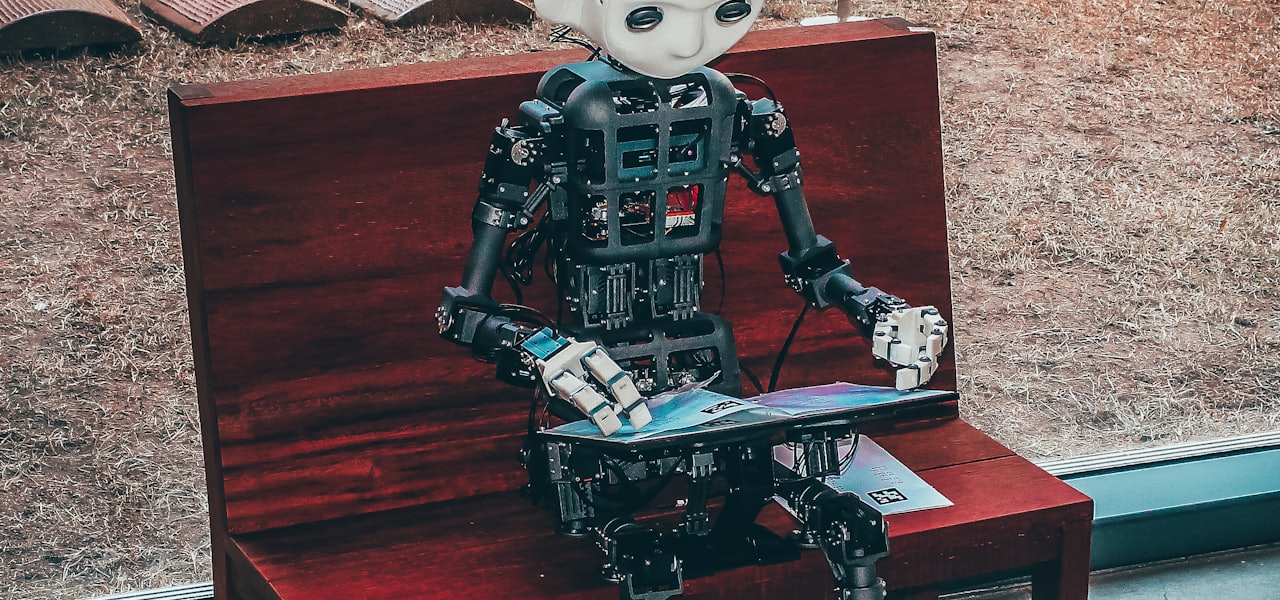
In artificial intelligence, an embodied agent, also sometimes referred to as an interface agent, is an intelligent agent that interacts with the environment through a physical body within that environment. Agents that are represented graphically with a body, for example a human or a cartoon animal, are also called embodied agents, although they have only virtual, not physical, embodiment. A branch of artificial intelligence focuses on empowering such agents to interact autonomously with human beings and the environment. Mobile robots are one example of physically embodied agents; Ananova and Microsoft Agent are examples of graphically embodied agents. Embodied conversational agents are embodied agents (usually with a graphical front-end as opposed to a robotic body) that are capable of engaging in conversation with one another and with humans employing the same verbal and nonverbal means that humans do (such as gesture, facial expression, and so forth). == Embodied conversational agents == Embodied conversational agents are a form of intelligent user interface. Graphically embodied agents aim to unite gesture, facial expression and speech to enable face-to-face communication with users, providing a powerful means of human-computer interaction. == Advantages == Face-to-face communication allows communication protocols that give a much richer communication channel than other means of communicating. It enables pragmatic communication acts such as conversational turn-taking, facial expression of emotions, information structure and emphasis, visualization and iconic gestures, and orientation in a three-dimensional environment. This communication takes place through both verbal and non-verbal channels such as gaze, gesture, spoken intonation and body posture. Research has found that users prefer a non-verbal visual indication of an embodied system's internal state to a verbal indication, demonstrating the value of additional non-verbal communication channels. As well as this, the face-to-face communication involved in interacting with an embodied agent can be conducted alongside another task without distracting the human participants, instead improving the enjoyment of such an interaction. Furthermore, the use of an embodied presentation agent results in improved recall of the presented information. Embodied agents also provide a social dimension to the interaction. Humans willingly ascribe social awareness to computers, and thus interaction with embodied agents follows social conventions, similar to human to human interactions. This social interaction both raises the believably and perceived trustworthiness of agents, and increases the user's engagement with the system. Rickenberg and Reeves found that the presence of an embodied agent on a website increased the level of user trust in that website, but also increased users' anxiety and affected their performance, as if they were being watched by a real human. Another effect of the social aspect of agents is that presentations given by an embodied agent are perceived as being more entertaining and less difficult than similar presentations given without an agent. Research shows that perceived enjoyment, followed by perceived usefulness and ease of use, is the major factor influencing user adoption of embodied agents. A study in January 2004 by Byron Reeves at Stanford demonstrated how digital characters could "enhance online experiences" through explaining how virtual characters essentially add a sense of familiarity to the user experience and make it more approachable. This increase in likability in turn helps make the products better, which benefits both the end users and those creating the product. === Applications === The rich style of communication that characterizes human conversation makes conversational interaction with embodied conversational agents ideal for many non-traditional interaction tasks. A familiar application of graphically embodied agents is computer games; embodied agents are ideal for this setting because the richer communication style makes interacting with the agent enjoyable. Embodied conversational agents have also been used in virtual training environments, portable personal navigation guides, interactive fiction and storytelling systems, interactive online characters and automated presenters and commentators. Major virtual assistants like Siri, Amazon Alexa and Google Assistant do not come with any visual embodied representation, which is believed to limit the sense of human presence by users. The U.S. Department of Defense utilizes a software agent called SGT STAR on U.S. Army-run Web sites and Web applications for site navigation, recruitment and propaganda purposes. Sgt. Star is run by the Army Marketing and Research Group, a division operated directly from The Pentagon. Sgt. Star is based upon the ActiveSentry technology developed by Next IT, a Washington-based information technology services company. Other such bots in the Sgt. Star "family" are utilized by the Federal Bureau of Investigation and the Central Intelligence Agency for intelligence gathering purposes.
View model
A view model or viewpoints framework in systems engineering, software engineering, and enterprise engineering is a framework which defines a coherent set of views to be used in the construction of a system architecture, software architecture, or enterprise architecture. A view is a representation of the whole system from the perspective of a related set of concerns. Since the early 1990s there have been a number of efforts to prescribe approaches for describing and analyzing system architectures. A result of these efforts have been to define a set of views (or viewpoints). They are sometimes referred to as architecture frameworks or enterprise architecture frameworks, but are usually called "view models". Usually a view is a work product that presents specific architecture data for a given system. However, the same term is sometimes used to refer to a view definition, including the particular viewpoint and the corresponding guidance that defines each concrete view. The term view model is related to view definitions. == Overview == The purpose of views and viewpoints is to enable humans to comprehend very complex systems, to organize the elements of the problem and the solution around domains of expertise and to separate concerns. In the engineering of physically intensive systems, viewpoints often correspond to capabilities and responsibilities within the engineering organization. Most complex system specifications are so extensive that no single individual can fully comprehend all aspects of the specifications. Furthermore, we all have different interests in a given system and different reasons for examining the system's specifications. A business executive will ask different questions of a system make-up than would a system implementer. The concept of viewpoints framework, therefore, is to provide separate viewpoints into the specification of a given complex system in order to facilitate communication with the stakeholders. Each viewpoint satisfies an audience with interest in a particular set of aspects of the system. Each viewpoint may use a specific viewpoint language that optimizes the vocabulary and presentation for the audience of that viewpoint. Viewpoint modeling has become an effective approach for dealing with the inherent complexity of large distributed systems. Architecture description practices, as described in IEEE Std 1471-2000, utilize multiple views to address several areas of concerns, each one focusing on a specific aspect of the system. Examples of architecture frameworks using multiple views include Kruchten's "4+1" view model, the Zachman Framework, TOGAF, DoDAF, and RM-ODP. == History == In the 1970s, methods began to appear in software engineering for modeling with multiple views. Douglas T. Ross and K.E. Schoman in 1977 introduce the constructs context, viewpoint, and vantage point to organize the modeling process in systems requirements definition. According to Ross and Schoman, a viewpoint "makes clear what aspects are considered relevant to achieving ... the overall purpose [of the model]" and determines How do we look at [a subject being modelled]? As examples of viewpoints, the paper offers: Technical, Operational and Economic viewpoints. In 1992, Anthony Finkelstein and others published a very important paper on viewpoints. In that work: "A viewpoint can be thought of as a combination of the idea of an “actor”, “knowledge source”, “role” or “agent” in the development process and the idea of a “view” or “perspective” which an actor maintains." An important idea in this paper was to distinguish "a representation style, the scheme and notation by which the viewpoint expresses what it can see" and "a specification, the statements expressed in the viewpoint's style describing particular domains". Subsequent work, such as IEEE 1471, preserved this distinction by utilizing two separate terms: viewpoint and view, respectively. Since the early 1990s there have been a number of efforts to codify approaches for describing and analyzing system architectures. These are often termed architecture frameworks or sometimes viewpoint sets. Many of these have been funded by the United States Department of Defense, but some have sprung from international or national efforts in ISO or the IEEE. Among these, the IEEE Recommended Practice for Architectural Description of Software-Intensive Systems (IEEE Std 1471-2000) established useful definitions of view, viewpoint, stakeholder and concern and guidelines for documenting a system architecture through the use of multiple views by applying viewpoints to address stakeholder concerns. The advantage of multiple views is that hidden requirements and stakeholder disagreements can be discovered more readily. However, studies show that in practice, the added complexity of reconciling multiple views can undermine this advantage. IEEE 1471 (now ISO/IEC/IEEE 42010:2011, Systems and software engineering — Architecture description) prescribes the contents of architecture descriptions and describes their creation and use under a number of scenarios, including precedented and unprecedented design, evolutionary design, and capture of design of existing systems. In all of these scenarios the overall process is the same: identify stakeholders, elicit concerns, identify a set of viewpoints to be used, and then apply these viewpoint specifications to develop the set of views relevant to the system of interest. Rather than define a particular set of viewpoints, the standard provides uniform mechanisms and requirements for architects and organizations to define their own viewpoints. In 1996 the ISO Reference Model for Open Distributed Processing (RM-ODP) was published to provide a useful framework for describing the architecture and design of large-scale distributed systems. == View model topics == === View === A view of a system is a representation of the system from the perspective of a viewpoint. This viewpoint on a system involves a perspective focusing on specific concerns regarding the system, which suppresses details to provide a simplified model having only those elements related to the concerns of the viewpoint. For example, a security viewpoint focuses on security concerns and a security viewpoint model contains those elements that are related to security from a more general model of a system. A view allows a user to examine a portion of a particular interest area. For example, an Information View may present all functions, organizations, technology, etc. that use a particular piece of information, while the Organizational View may present all functions, technology, and information of concern to a particular organization. In the Zachman Framework views comprise a group of work products whose development requires a particular analytical and technical expertise because they focus on either the “what,” “how,” “who,” “where,” “when,” or “why” of the enterprise. For example, Functional View work products answer the question “how is the mission carried out?” They are most easily developed by experts in functional decomposition using process and activity modeling. They show the enterprise from the point of view of functions. They also may show organizational and information components, but only as they relate to functions. === Viewpoints === In systems engineering, a viewpoint is a partitioning or restriction of concerns in a system. Adoption of a viewpoint is usable so that issues in those aspects can be addressed separately. A good selection of viewpoints also partitions the design of the system into specific areas of expertise. Viewpoints provide the conventions, rules, and languages for constructing, presenting and analysing views. In ISO/IEC 42010:2007 (IEEE-Std-1471-2000) a viewpoint is a specification for an individual view. A view is a representation of a whole system from the perspective of a viewpoint. A view may consist of one or more architectural models. Each such architectural model is developed using the methods established by its associated architectural system, as well as for the system as a whole. === Modeling perspectives === Modeling perspectives is a set of different ways to represent pre-selected aspects of a system. Each perspective has a different focus, conceptualization, dedication and visualization of what the model is representing. In information systems, the traditional way to divide modeling perspectives is to distinguish the structural, functional and behavioral/processual perspectives. This together with rule, object, communication and actor and role perspectives is one way of classifying modeling approaches === Viewpoint model === In any given viewpoint, it is possible to make a model of the system that contains only the objects that are visible from that viewpoint, but also captures all of the objects, relationships and constraints that are present in the system and relevant to that viewpoint. Such a model is said to be a viewpoint model, or a view of the
Google Messages
Google Messages (formerly known as Messenger, Android Messages, and Messages by Google) is a text messaging software application developed by Google for its Android and Wear OS mobile operating systems. It is also available as a web app. Google's official universal messaging platform for the Android ecosystem, Messages employs SMS, MMS, and Rich Communication Services (RCS). Starting in 2023, Google has RCS activated by default on participating Android devices, similar to the implementation of iMessage on Apple devices. Samsung Messages will be discontinued on July 6th 2026, with Samsung transitioning users to Google Messages as the default messaging application. == History == The original code for Android SMS messaging was released in 2009 integrated into the operating system. It was released as a standalone application independent of Android with the release of Android 5.0 Lollipop in 2014, replacing Google Hangouts as the default SMS app on Google's Nexus line of phones. In 2018, Messages adopted RCS messages and evolved to send larger data files, sync with other apps, and even create mass messages. This was in preparation for when Google launched Messages for web. In December 2019, Google began to introduce support for Rich Communication Services (RCS) messaging via an RCS service hosted by Google, referred to in the user interface as "chat features". This was followed by a wider global rollout throughout 2020. The app surpassed 1 billion installs in April 2020, doubling its number of installs in less than a year. Initially, RCS did not support end-to-end encryption. In June 2021, Google introduced end-to-end encryption in Messages by default using the Signal Protocol, for all one-to-one RCS-based conversations, for all RCS group chats in December 2022 for beta users, and for all RCS users by August 2023, as well as enabling RCS for all users by default to encourage encryption. In July 2023, Google announced it would build the Message Layer Security (MLS) end-to-end encryption protocol into Google Messages. Beginning with the Samsung Galaxy S21, Messages replaces Samsung's in-house Messages app as the default text messaging app for One UI for some regions and carriers. In April 2021, the app began to receive UI modifications on Samsung devices to follow aspects of One UI, including pushing the top of the message list towards the middle of the screen to improve ergonomics. In February 2023, Google began to replace references to "chat features" in the Messages user interface with "RCS". In August 2023, Google announced that Messages will use RCS by default for all users unless they opt out, to allow them to benefit from secure messaging. In December 2023, with the arrival of several new features, the app was renamed "Google Messages". In July 2024, Samsung announced it would no longer pre-install Samsung Messages on its Galaxy devices in some regions, starting with the Galaxy Z Fold 6 and Flip, favoring Google Messages instead. In April 2026, Samsung announced that Samsung Messages would be discontinued in July 2026. It encouraged users to switch to Google Messages. == Features == Some of the most important features in Google Messages are: Send instant text and voice messages in 1:1 or group chat conversations over mobile data and Wi-Fi, via Android, Wear OS or the web. End-to-end encryption for RCS chats. Typing, sent, delivered and read status Reply and react to specific messages Share files and high-resolution photos Voice message transcriptions Schedule messages In-app reminders for birthdays and messages you didn't respond to after some time with Nudges Tight integration with the Google ecosystem, e.g. Google Calendar, Meet, Maps, YouTube, Photos, Contacts, Assistant, Search, Safe Browsing etc. Web interface: Users can visit https://messages.google.com/web and either sign in with their Google account or scan the QR code that is shown with their smartphone to access a limited web version of the app that allows them to send and receive messages, provided the smartphone remains connected. Phone number recognition: The app shows the country and province of the caller. Additionally, it can show the company's name or a warning for spam calls if the number is registered in a data base. Access to the Gemini chatbot on select Pixel, Galaxy and Android devices.
Cloudflare
Cloudflare, Inc., is an American technology company headquartered in San Francisco, California, that provides a range of internet services, including content delivery network (CDN) services, cloud cybersecurity, DDoS mitigation, and ICANN-accredited domain registration. The company's services act primarily as a reverse proxy between website visitors and a customer's hosting provider, improving performance and protecting against malicious traffic. Cloudflare was founded in 2009 by Matthew Prince, Lee Holloway, and Michelle Zatlyn. The company went public on the New York Stock Exchange in 2019 under the ticker symbol NET. Cloudflare has since expanded its offerings to include edge computing through its Workers platform, a public DNS resolver (1.1.1.1), and a VPN-like service known as WARP. In recent years, the company has integrated artificial intelligence into its infrastructure, acquiring companies such as Replicate and launching tools to manage AI bots and scrapers. According to W3Techs, Cloudflare is used by approximately 21.3% of all websites on the Internet as of January 2026. The company has been the subject of controversy regarding its policy of content neutrality. While Cloudflare executives have historically advocated for remaining a neutral infrastructure provider, the company has terminated services for specific high-profile websites associated with hate speech and violence, including The Daily Stormer, 8chan, and Kiwi Farms, following significant public pressure. Cloudflare has also faced criticism and litigation regarding copyright infringement by websites using its services, notably losing a lawsuit against Japanese publishers in 2025. The company experienced significant global outages in late 2025 which disrupted services for major platforms internationally. == History == Cloudflare was founded on July 26, 2009, by Matthew Prince, Lee Holloway, and Michelle Zatlyn. Prince and Holloway had previously collaborated on Project Honey Pot, a product of Unspam Technologies that partly inspired the basis of Cloudflare. In 2009, the company was venture-capital funded. On August 15, 2019, Cloudflare submitted its S-1 filing for an initial public offering on the New York Stock Exchange under the stock ticker NET. It opened for public trading on September 13, 2019, at $15 per share. According to the company, the name 'Cloudflare' was chosen, over the initial 'WebWall', because it best described what they were trying to do: build a "firewall in the cloud." In 2020, Cloudflare co-founder and COO Michelle Zatlyn was named president. Cloudflare has acquired web-services and security companies, including StopTheHacker (February 2014), CryptoSeal (June 2014), Eager Platform Co. (December 2016), Neumob (November 2017), S2 Systems (January 2020), Linc (December 2020), Zaraz (December 2021), Vectrix (February 2022), Area 1 Security (February 2022), Nefeli Networks (March 2024), BastionZero (May 2024), and Kivera (October 2024). Replicate (November 2025), and Human Native (January 2026). Since at least 2017, Cloudflare has used a wall of lava lamps at its San Francisco headquarters as a source of randomness for encryption keys, alongside double pendulums at its London offices and a Geiger counter at its Singapore offices. The lava lamp installation implements the Lavarand method, where a camera transforms the unpredictable shapes of the "lava" blobs into a digital image. In Q4 2022, Cloudflare provided paid services to 162,086 customers. In October 2024, Cloudflare won a lawsuit against patent troll Sable Networks. Sable paid Cloudflare $225,000, granted it a royalty-free license to its patent portfolio, and dedicated its patents to the public by abandoning its patent rights. In November 2025, it was announced Cloudflare had agreed to acquire Replicate, a San Francisco–based platform that enables software developers to run, fine-tune, and deploy open-source machine-learning models via an API without managing infrastructure. In January 2026, Cloudflare released an analysis regarding BGP routing leaks observed from the Venezuelan state-owned ISP CANTV (AS8048), which occurred on January 2 coincides with the arrest of Nicolás Maduro. While some security researchers had speculated that the outages were linked to U.S. cyber operations, Cloudflare's data indicated that the anomalies were consistent with a pattern of "insufficient routing export and import policies" by the ISP rather than malicious external interference. In January 2026, Cloudflare acquired Human Native, an AI data marketplace that brokers transactions between developers and content creators, for an undisclosed amount. On January 16, 2026, Cloudflare acquired The Astro Technology Company, the developers behind the open-source web framework Astro. In May 2026, Cloudflare announced the elimination of approximately 1,100 positions, around 20 percent of its workforce, in a restructuring the company attributed to the rapid adoption of artificial intelligence tools. The announcement coincided with the company's first-quarter 2026 earnings, which reported a record $639.8 million in quarterly revenue, a 34 percent year-over-year increase. CEO Matthew Prince stated the cuts were not driven by performance concerns but reflected roles made obsolete by AI, and that Cloudflare expected to employ more people by the end of 2027 than at any point during 2026. == Products == Cloudflare provides network and security products for consumers and businesses, utilizing edge computing, reverse proxies for web traffic, data center interconnects, and a content distribution network to serve content across its network of servers. It supports transport layer protocols TCP, UDP, QUIC, and many application layer protocols such as DNS over HTTPS, SMTP, and HTTP/2 with support for HTTP/2 Server Push. As of 2023, Cloudflare handles an average of 45 million HTTP requests per second. As of 2024, Cloudflare servers are powered by AMD EPYC 9684X processors. Cloudflare also provides analysis and reports on large-scale outages, including Verizon's October 2024 outage. === Artificial intelligence === In 2023, Cloudflare launched "Workers AI", a framework allowing for use of Nvidia GPU's within Cloudflare's network. In 2024, Cloudflare launched a tool that prevents bots from scraping websites. To build automatic bot detector models, the company analyzed "AI" bots and crawler traffic. The company also launched an "AI" assistant to generate charts based on queries by leveraging "Workers AI". Cloudflare announced plans in September 2024 to launch a marketplace where website owners can sell "AI" model providers access to scrape their site's content. In March 2025, Cloudflare announced a new feature called "AI Labyrinth", which combats unauthorized "AI" data scraping by serving fake "AI"-generated content to LLM bots. In July, the company rolled out a permission-based setting to allow websites to automatically block online bots from scraping data and content. Cloudflare released AutoRAG into beta in 2025. AutoRAG (retrieval augmented generation) creates a vector database of a website's unstructured content to identify relationships between concepts. It is part of an initiative with Microsoft, alongside their NLWeb standard, to make websites easier for people and automated systems to query. Cloudflare and GoDaddy partnered in April 2026 to enable AI Crawl Control features on GoDaddy hosted websites. This would allow site owners to decide how AI bot crawlers interact with their content. === DDoS mitigation === Cloudflare provides free and paid DDoS mitigation services that protect customers from distributed denial of service (DDoS) attacks. Cloudflare received media attention in June 2011 for providing DDoS mitigation for the website of LulzSec, a black hat hacking group. In March 2013, The Spamhaus Project was targeted by a DDoS attack that Cloudflare reported exceeded 300 gigabits per second (Gbit/s). Patrick Gilmore, of Akamai, stated that at the time it was "the largest publicly announced DDoS attack in the history of the Internet". While trying to defend Spamhaus against the DDoS attacks, Cloudflare ended up being attacked as well; Google and other companies eventually came to Spamhaus' defense and helped it to absorb the unprecedented amount of attack traffic. In 2014, Cloudflare began providing free DDoS mitigation for artists, activists, journalists, and human rights groups under the name "Project Galileo". In 2017, it extended the service to electoral infrastructure and political campaigns under the name "Athenian Project". By 2025, more than 2,900 users and organizations were participating in Project Galileo, including 31 US states. In February 2014, Cloudflare claimed to have mitigated an NTP reflection attack against an unnamed European customer, which it stated peaked at 400 Gbit/s. In November 2014, it reported a 500 Gbit/s DDoS attack in Hong Kong. In July 2021, the company claimed to have absorbed a DDoS atta
Alexander Y. Tetelbaum
Alexander Y. Tetelbaum (born August 16, 1948) is a Ukrainian American computer scientist, inventor, and academic who has contributed to electronic design automation (EDA) and artificial intelligence (AI) since the late 1960s; and holds 46 U.S. patents in EDA and related fields. Tetelbaum is the founding president of International Solomon University, the first Jewish university in Ukraine, established during a period of renewed efforts to address antisemitism in Ukraine. == Early life and education == He graduated from a Kyiv mathematical high school with a silver medal in 1966. Tetelbaum enrolled at the Kyiv Polytechnic Institute (KPI), now National Technical University of Ukraine "Igor Sikorsky Kyiv Polytechnic Institute" in 1966, graduating in 1972 with an MS in Electronics with honors. He earned his PhD in Electrical and Computer Engineering from KPI in 1975, with a dissertation on electronic design automation, and his Doctor of Engineering Science in 1986. == Academic career == Tetelbaum began his academic career at KPI in 1973 as a junior scientist, becoming a professor in the Computer and Electrical Engineering Department in 1980. Later, he founded and served as president of International Solomon University in Kyiv from 1991 to 1996, the first Jewish university in Ukraine. The university became a major academic center for computer science and Jewish studies in the post-Soviet era. He was a visiting and adjunct professor at Michigan State University from 1993 to 1996. == Professional career == Tetelbaum worked as an engineer at the Kiev Institute of Cybernetics from 1972 to 1973, and later, he led the Design Automation Lab at Kyiv Polytechnic Institute from 1975 to 1987. In the United States, he served as EDA manager at Silicon Graphics Corporation from 1996 to 1998 and principal engineer at LSI Corporation from 1998 to 2012. He founded and served as CEO of Abelite Design Automation, Inc., from 2012 to 2022. == Contributions in computer science == Tetelbaum has contributed to electronic design automation (EDA) and artificial intelligence (AI) since the 1960s. His early work included methods for EDA, particularly physical design automation and mathematical optimization; and he developed force-directed placement and topological routing methods. Tetelbaum generalized Rent's rule for hierarchical systems and large blocks, proposing a graph-based framework that extends applicability to arbitrary partition sizes with improved accuracy. Additional IEEE and related conference contributions from the mid-1990s include: "Path Search for Complicated Function", 1995 IEEE International Symposium on Circuits and Systems "A Performance-driven Placement Approach of Standard Cells" (International Conference on Intelligent Systems, 1995) "Framework of a New Methodology for Behavioral to Physical Design Linkage" (38th Midwest Symposium on Circuits and Systems, 1996) Statistical timing design and variations Test Methodologies These and other works and patents contributed to timing-driven placement, crosstalk reduction, clock tree synthesis, and interconnect optimization in VLSI design. == Patents == Tetelbaum holds 46 U.S. patents in EDA and related fields. Notable examples include: For the full list of patents, see Justia Patents or Google Patents. == Publications == === Early publications in the Soviet Union === Before the appearance of American books on electronic design automation (EDA), Tetelbaum published several scientific books and monographs on the subject in Russian/Ukrainian. Electronic Design Automation, Kiev: Znanie Publisher, 1975. Planar Design of Electronic Circuits, Kiev: Znanie Publisher, 1977. Formal Design of Computer Systems, Moscow: Sovetskoe Radio, 1979. CAD of Electronic Equipment: Topological Approach, Kiev: Vyssha Shkola, 1980; 2nd ed. 1981. Automated Design of Electronic Circuits (1981) CAD of VLSI Circuits, Kiev: Vyssha Shkola, 1983. Topological Algorithms of Multilayer Printed Circuit Boards Routing, Moscow: Radio i Svyaz, 1983. CAD of VLSI Circuits on Master Slice Chips, Moscow: Radio i Svyaz, 1988. Increasing the Effectiveness of CAD Systems, Kiev: UMKVO, 1991. === Scientific Monographs (English) === Minimum Number of Timing Signoff Corners (2022) Interviewing AI (2026) The AI Debate (2026) New Nostradamus Predictions: 2026: The Next Decade & Beyond (2035–2050+) (2026) For a consolidated record of Tetelbaum's publications, see Alexander Y. Tetelbaum, Wikidata Q4720205. === Other publications === Tetelbaum also published educational books on problem-solving methods: Yes-No Puzzles-Games Puzzle Games for Kids Solving Non-Standard Problems Solving Non-Standard Very Hard Problems Additionally, Tetelbaum published three thrillers: Omerta Operations Executive Director Eruption Yacht Finally, he published his memoir and an entertaining book: Unfinished Equations Artificially Intelligent Humor
Shopify
Shopify Inc., stylized as shopify, is a Canadian multinational e-commerce company headquartered in Ottawa, Ontario that operates a platform for retail point-of-sale systems. The company has over 5 million customers and processed US$292.3 billion in transactions in 2024, of which 57% was in the United States. Major customers include Tesla, LVMH, Nestlé, PepsiCo, AB InBev, Kraft Heinz, Lindt, Whole Foods Market, Red Bull, and Hyatt. The company's software has been praised for its ease of use and reasonable fee structure. It has been described as the "go-to e-commerce platform for startups". However, the company has faced criticism for allegedly inflating their sales data and for associating with controversial sellers. == History == === 2006: Founding === Shopify was founded in 2006 by friends Tobias Lütke, Daniel Weinand and Scott Lake after launching Snowdevil, an online store for snowboarding equipment, in 2004. Dissatisfied with the existing e-commerce products on the market, Lütke, a computer programmer by trade, instead built his own. Lütke used the open source web application framework Ruby on Rails to build Snowdevil's online store and launched it after two months of development. The Snowdevil founders launched the platform as Shopify in June 2006. Shopify created an open-source template language called Liquid, which is written in Ruby and has been used since 2006. In June 2009, Shopify launched an application programming interface (API) platform and App Store. The API allows developers to create applications for Shopify online stores and then sell them on the Shopify App Store. === 2010s === In January 2010, Shopify started its Build-A-Business competition, in which participants create a business using its commerce platform. The winners of the competition received cash prizes and mentorship from entrepreneurs, such as Richard Branson, Eric Ries and others. In April of that year, Shopify launched a free mobile app on the Apple App Store. The app allows Shopify store owners to view and manage their stores from iOS mobile devices. In December 2010, Shopify raised $7 million from a series A round from Bessemer Venture Partners, FirstMark Capital, and Felicis Ventures at a $20 million pre-money valuation. At that time, the company had annualized transaction value of $132 million. In October 2011, it raised $15 million in a Series B round. In August 2013, Shopify launched Shopify Payments in partnership with Stripe. Shopify Payments allows merchants to accept payments without requiring a third-party payment gateway. The company also announced the launch of a point of sale system to enable in-person sales in addition to online. The company received $100 million in Series C funding in December 2013. Shopify earned $105 million in revenue in 2014, twice as much as it raised the previous year. In February 2014, Shopify released "Shopify Plus" for large e-commerce businesses seeking access to additional features and support. Shopify went public via an initial public offering on May 21, 2015 raising more than $131 million. In September 2015, Amazon.com closed its Amazon Webstore service for merchants and selected Shopify as the preferred migration provider; In April 2016, Shopify announced Shopify Capital, a cash advance product. Shopify Capital was initially piloted to merchants within the US and allowed merchants to receive an advance on future earnings processed through its payment gateway. Since its launch in 2016, Shopify Capital has provided more than $5.1 billion in funding to Shopify merchants, with a maximum advance of $2 million. On June 7, 2016, Shopify launched its Shopify Plus Partners Program, to help agencies connect with evolving businesses in ecommerce space. On October 3, 2016, Shopify acquired Boltmade. In November 2016, Shopify partnered with Paystack which allowed Nigerian online retailers to accept payments from customers around the world. On November 22, 2016, Shopify launched Frenzy, a mobile app that improves flash sales. In January 2017, Shopify announced integration with Amazon that would allow merchants to sell on Amazon from their Shopify stores. In April 2017, Shopify introduced its Chip & Swipe Reader, a Bluetooth enabled debit and credit card reader for brick and mortar retail purchases. The company has since released additional technology for brick and mortar retailers, including a point-of-sale system with a Dock and Retail Stand similar to that offered by Square, and a tappable chip card reader. Shopify announced a one-click accelerated checkout feature called Shopify Pay in April 2017 as an exclusive feature for merchants using Shopify Payments as their payment processor. Customers can save their shipping and payment information for future purchases from all participating Shopify stores. In November 2017 Shopify announced Arrive, a mobile application to help customers track packages from both Shopify merchants and other e-commerce websites. In September 2018, Shopify announced plans to expand its office space in Toronto's King West neighborhood in 2022 as part of "The Well" complex, jointly owned by Allied Properties REIT and RioCan REIT. In October 2018, Shopify opened its first flagship, a physical space for business owners in Los Angeles. The space offered educational classes, coworking space, a "genius bar" for companies that use Shopify software, and workshops. Online cannabis sales in Ontario, Canada, used Shopify's software when the drug was legalized in October 2018. Shopify's software is also used for in-person cannabis sales in Ontario since becoming legal in 2019. In January 2019, Shopify announced the launch of Shopify Studios, a full-service television and film content and production house. On March 22, 2019, Shopify and email marketing platform Mailchimp ended an integration agreement over disputes involving customer privacy and data collection. In April 2019, Shopify announced an integration with Snapchat to allow Shopify merchants to buy and manage Snapchat Story ads directly on the Shopify platform. The company had previously secured similar integration partnerships with Facebook and Google. On August 14, 2019, Shopify launched Shopify Chat, a new native chat function that allows merchants to have real-time conversations with customers visiting Shopify stores online. === 2020s === In January 2020, the company announced plans to hire in Vancouver, Canada. Additionally, the effects of the COVID-19 pandemic contributed to lifting stock prices. On February 21, 2020, Shopify announced plans to join the Diem Association, known as Libra Association at the time. Also that month, Shopify Pay was rebranded as Shop Pay. In April, Arrive was rebranded as Shop, combining both customer-facing features under a single brand. In May, during the COVID-19 pandemic, Shopify announced it would shift most of its global workforce to permanent remote work. It was reported that Shopify's valuation would likely rise on the back of options it had in the company Affirm that was expecting to go public shortly. In November 2020, Shopify announced a partnership with Alipay to support merchants with cross-border payments. Shopify also provided the opportunity for users to connect Alibaba and AliExpress to Shopify through a Alibaba Dropshipping app that could be purchased through the Shopify App Store. Multiple applications launched between 2021 and 2024 allowed customers to connect their Shopify store to their Alibaba account and then import and publish your products. The integration automatically syncs inventory and orders between both platforms so that Alibaba vendors can ship directly to dropshipping customers.As a result of Affirm's January 13, 2021 IPO, Shopify's 8% stake in Affirm was worth $2 billion. About half of Shopify's C-level executives left the company in early 2021. On June 29, 2021, Shopify removed the 20% revenue share for app developers that make less than US$1 million per year. On January 18, 2022, Shopify announced a partnership with JD.com to let U.S. merchants expand their operations in China, listing their products on JD's cross-border e-commerce platform JD Worldwide. On March 22, 2022, Shopify introduced Linkpop, a product to create a branded, social marketplace through which merchants can advertise and market their products via links to be added on social media channels. The following month, Shopify, Alphabet Inc., Meta Platforms, McKinsey & Company, and Stripe, Inc. announced a $925 million advance market commitment of carbon dioxide removal (CDR) from companies that are developing CDR technology over the next 9 years. In June 2022, Shopify partnered with Twitter. As a part of the deal, Twitter announced that it would launch a sales channel app for all of Shopify's U.S. merchants through its app store. Shopify also partnered with PayPal to offer Shopify Payments to merchants in France. On July 26, 2022, Lütke announced immediate layoffs totalling roughly 10 percent of its workforce. In