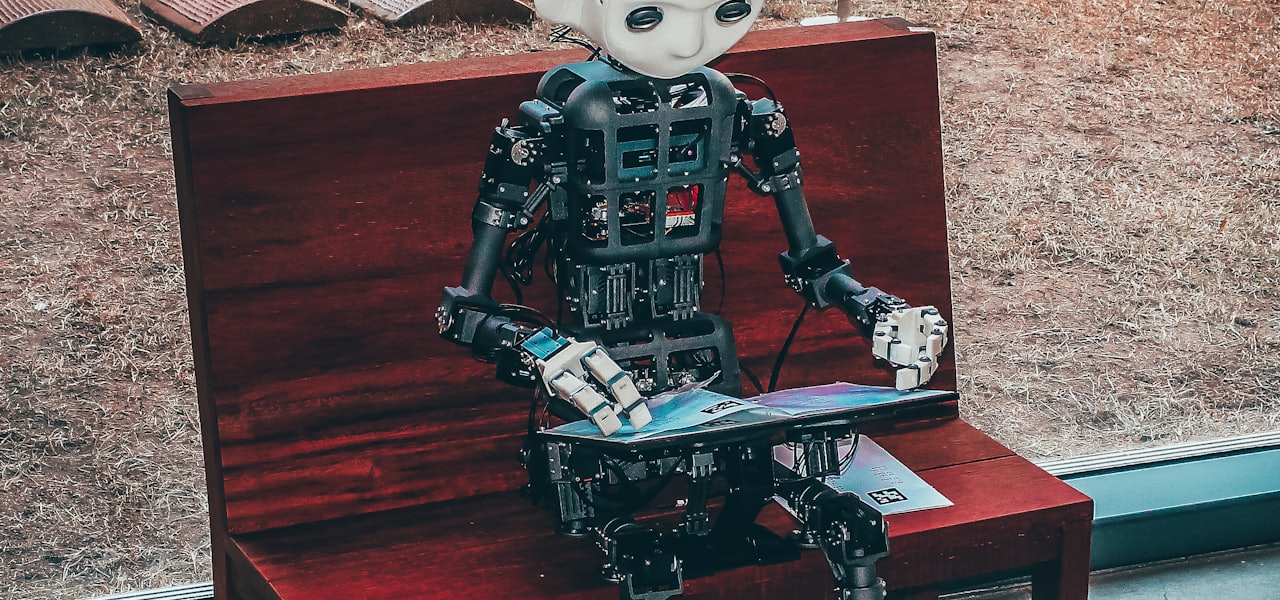
An autonomous agent is an artificial intelligence (AI) system that can perform complex tasks independently. == Definitions == There are various definitions of autonomous agent. According to Brustoloni (1991): "Autonomous agents are systems capable of autonomous, purposeful action in the real world." According to Maes (1995): "Autonomous agents are computational systems that inhabit some complex dynamic environment, sense and act autonomously in this environment, and by doing so realize a set of goals or tasks for which they are designed." Franklin and Graesser (1997) review different definitions and propose their definition: "An autonomous agent is a system situated within and a part of an environment that senses that environment and acts on it, over time, in pursuit of its own agenda and so as to effect what it senses in the future." They explain that: "Humans and some animals are at the high end of being an agent, with multiple, conflicting drives, multiples senses, multiple possible actions, and complex sophisticated control structures. At the low end, with one or two senses, a single action, and an absurdly simple control structure we find a thermostat." == Agent appearance == Lee et al. (2015) post safety issue from how the combination of external appearance and internal autonomous agent have impact on human reaction about autonomous vehicles. Their study explores the human-like appearance agent and high level of autonomy are strongly correlated with social presence, intelligence, safety and trustworthiness. In specific, appearance impacts most on affective trust while autonomy impacts most on both affective and cognitive domain of trust where cognitive trust is characterized by knowledge-based factors and affective trust is largely emotion driven. == Applications == Agentic AI systems: Advanced AI agents that can scope out projects and complete them with necessary tools, representing a significant evolution from simple task-oriented systems. Internet of things (IoT) Integration: Autonomous agents increasingly interact with IoT devices, enabling smart home systems, industrial monitoring, and urban infrastructure management. Collaborative software development: Tools like Cognition AI's Devin aim to create autonomous software engineers capable of complex reasoning, planning, and completing engineering tasks requiring thousands of decisions. Enterprise automation: Business process automation platforms like Salesforce's Agentforce provide autonomous bots for various service functions. == Challenges and considerations == Uncertainty and incomplete information: Autonomous agents must make decisions with limited or uncertain information about their environment and future states. Integration complexity: Incorporating autonomous agents into existing systems and workflows can be technically challenging and resource-intensive. Scalability: As systems become more complex and more agents are used, maintaining coordination and avoiding conflicts becomes increasingly difficult. Trust: Research has shown the combination of external appearance and internal autonomous capabilities significantly impacts human reactions and trust. Lee et al. (2015) found that human-like appearance and high levels of autonomy are strongly correlated with social presence, intelligence, safety, and trustworthiness perceptions. Specifically, appearance impacts affective trust most significantly, while autonomy affects both affective and cognitive trust domains, where affective trust is emotionally driven, and cognitive trust is characterized by knowledge-based factors. Vulnerability to manipulation: Researchers from Harvard, MIT and other educational institutions found that AI agents could become vulnerable to manipulation and could perform detrimental actions in the process of being helpful. == Ethical and regulatory concerns == Accountability: Determining responsibility when autonomous agents make incorrect or harmful decisions remains a complex issue. Privacy and security: autonomous agents often require access to sensitive data, raising concerns about data protection and system security.
Live Transcribe
Live Transcribe is a mobile app for real-time captioning, developed by Google for the Android operating system. Development on the application began in partnership with Gallaudet University. It was publicly released as a free beta for Android 5.0+ on the Google Play Store on February 4, 2019. As of early 2023 it had been downloaded over 500 million times. == Development == Researchers Dimitri Kanevsky, Sagar Savla and Chet Gnegy at Google developed the app in collaboration with researchers at Gallaudet University, an American university for the education of the deaf and hard of hearing. The app uses machine learning to generate captions, similar to YouTube's auto-generated captions. In August 2019, Google made Live Transcribe an open-source project. == Features == The app uses speech recognition to generate live captions in over 80 languages with varying accuracy. The app, which requires connection to the Internet to function, is available to download on the Google Play Store. A later update to the app displayed information on sounds such as clapping, laughter, music, applause, and whistling. In May 2020, the app started supporting transcription in Albanian, Burmese, Estonian, Macedonian, Mongolian, Punjabi, and Uzbek, supporting 70 languages. In March 2022, the app was updated with support to transcribe offline, without Internet connection, so long as the appropriate language pack has been installed. The offline mode is only available for devices with 6GB of RAM and certain Google Pixel devices.
Pixorial
Pixorial was a cloud-based consumer photo sharing, video sharing and video editing platform. The company was formed in 2007 in Centennial, Colorado as a media conversion service. In 2013, Pixorial was chosen as one of two video storage companies to partner with the launch of Google Drive. Pixorial allowed users to edit and share videos on social channels by connecting through their Pixorial account. The company closed on July 18, 2014, and its assets were acquired by LifeLogger Technologies Corp in November 2015. == History == The company was founded in 2007 and launched in 2009 by former Netscape employee Andres Espineira. Changing its focus to video editing software in 2009, Pixorial began developing an app that would be launched for iOS and Android devices in 2011. Later developments in the app in 2012 would also included real time filters, which were later removed. With the launch of Google Drive in 2012, Pixorial was chosen as an integrated video partner. This integration with Google Drive allowed users to access videos stored in Google Drive within the web app of Pixorial. After the Google Drive launch, Pixorial developed a crowdsourced, location-based video sharing app, Krowds. The app was cited in July 2012 by PC Magazine as one of "The 8 Best Apps for Making and Sharing Videos on Your iPhone". In late July, Pixorial replaced its original mobile app with the MyPlayer HD app that optimized HD video viewing for large screen viewing including tablets and smart televisions. Pixorial's services terminated on July 18, 2014. == Products == === Krowds App === Pixorial's app was launched in April 2013 for iOS, and in May for Android, as a tool to aggregate event videos through location based collections. The app was launched to generally positive reviews. === Movie Creator === Launched July 12, 2012 Pixorial's Movie Creator allowed users to edit movies in a simple story-telling platform Movie Creator's features include transitions, text boxes, access to free music tracks, credits, and social media sharing capabilities. The Pixorial platform allowed users to view, share, and edit videos without modifying the original. Movie Creator integrated pictures and video to create user movies. == Awards == 2012 Apex Award from the Colorado Technology Association, for Best Technology Project of the Year 2010 Computerworld Laureate for Media, Arts and Entertainment
VoxForge
VoxForge is a free speech corpus and acoustic model repository for open source speech recognition engines. VoxForge was set up to collect transcribed speech to create a free GPL speech corpus in order to be uses with open source speech recognition engines. The speech audio files will be 'compiled' into acoustic models for use with open source speech recognition engines such as Julius, ISIP, and Sphinx and HTK (note: HTK has distribution restrictions). VoxForge has used LibriVox as a source of audio data since 2007.
Logogen model
The logogen model of 1969 is a model of speech recognition that uses units called "logogens" to explain how humans comprehend spoken or written words. Logogens are a vast number of specialized recognition units, each able to recognize one specific word. This model provides for the effects of context on word recognition. == Overview == The word logogen can be traced back to the Greek-language word logos, which means "word", and genus, which means "birth". British scientist John Morton's logogen model was designed to explain word recognition using a new type of unit known as a logogen. A critical element of this theory is the involvement of lexicons, or specialized aspects of memory that include semantic and phonemic information about each item that is contained in memory. A given lexicon consists of many smaller, abstract items known as logogens. Logogens contain a variety of properties about given word such as their appearance, sound, and meaning. Logogens do not store words within themselves, but rather they store information that is specifically necessary for retrieval of whatever word is being searched for. A given logogen will become activated by psychological stimuli or contextual information (words) that is consistent with the properties of that specific logogen and when the logogen's activation level rises to or above its threshold level, the pronunciation of the given word is sent to the output system. Certain stimuli can affect the activation levels of more than one word at a time, usually involving words that are similar to one another. When this occurs, whichever of the words' activation levels reaches the threshold level, it is that word that is then sent to the output system with the subject remaining unaware of any partially excited logogens. This assumption was made by Marslen-Wilson and Welch (1978), who added to the model some assumptions of their own in order to account for their experimental results. They also assumed that the analysis of phonetic input can only become available to other parts of the system by process of how the input affects the logogen system. Finally, Marslen-Wilson and Welch assume that the first syllable of a given word will increase the activation level of a given logogen more than those of the latter syllables, which supported the data found at the time. == Analysis == The logogen model can be used to help linguists explain particular occurrences in the human language. The most-helpful application of the model is to show how one accesses words and their meanings in the lexicon. The word-frequency effect is best explained by the logogen model in that words (or logogens) that have a higher frequency (or are more common) have a lower threshold. This means that they require less perceptual power in the brain to be recognized and decoded from the lexicon and are recognized faster than those words that are less common. Also, with high-frequency words, the recovery from lowering the item's threshold is less fulfilled compared to low-frequency words so less sensory information is needed for that particular item's recognition. There are ways to lower thresholds, such as repetition and semantic priming. Also, each time a word is encountered through these methods, the threshold for that word is temporarily lowered partially because of its recovering ability. This model also conveys that specific concrete words are recalled better because they use images and logogens, whereas abstract words are not as easily recalled well because they only use logogens, hence showing the difference in thresholds between these two types of words. At the time of its conception, Morton's logogen model was one of the most influential models in springing up other parallel word access models and served as the essential basis for these subsequent models. Morton's model also strongly influenced other contemporary theories on lexical access. However, despite the advantages that the logogen theory presents, it also displays some negative facets. First and foremost, the logogen model does not explain all occurrences in language, such as the introduction of new words or non-words into a person's lexicon. Also, because of the distinctive model application, it may vary in its effectiveness in different languages. == Criticisms == While this model does a reasonable job of understanding the underlying semantics of many aspects in psycholinguistics, there are some flaws that have been pointed out in the logogen model. It has been argued that the prior stimulus patterns that have been seen in the logogen theory are not centrally localized in the logogen itself but are actually distributed throughout the different pathways over which the stimulus is being processed. What this directs at is that the notion and proliferation of logogens was due to modality. In essence, the logogen is unnecessary in the idea of attaining the title of being a recognition unit because of the variety of pathways that it is open to, not just logogens. Another criticism has been that this model essentially ignores larger and more critical structures in language and phonetics such as the different syntactic rules or grammatical construction that innately exists in language. Since this model overtly limits itself to the scope of lexical access then this model is seen as biased and misunderstood. To many psychologists, the logogen model does not meet the functional or representational adequacy that a theory should include to sufficiently comprehend language. Also, another criticism is that the logogen theory was supposed to predict that stimulus degradation should affect priming and word frequency in humans. However, many psychologists have conducted studies and researched the model to show that only priming and not word frequency is interacted with stimulus degradation. Priming is supposed to deteriorate a stimulus because it postulates that the semantic characteristics of previously known words are fed back into the detector of a person which in turn raises the threshold of related items. In word frequency, stimulus degradation is supposed to occur because it postulates that familiar words have lower thresholds than their low-frequency counterparts. However, in studies, priming is the only structure that does show observable and notable stimulus decadence. Even though the logogen theory has many unfilled holes, Morton was a revolutionary of his field whose speculation and research has opened up a remarkable era of psycholinguistics. == Other models to consider == cohort model – This model was proposed by Marslen-Wilson and was designed specifically to account for auditory word recognition. It works by breaking the word down and states that when a word is heard all words that begin with the first sound of the target word are activated. This set of words is considered the cohort. Once the first cohort has been activated, the other information, or sounds in the word narrow down the choices. The person recognizes the word when you are left with a single choice; this is considered the "recognition point". checking model – This model was developed by Norris in 1986. In this particular model, he took the approach that any word that partially matches the input is analyzed and checked to see if it fits with the context of the situation. interactive-activation model – This model is considered a connectionist model. Proposed by McClelland and Rumelhart in the 1981 to 1982 period, it is based around nodes, which are visual features, and positions of letters within a given word. They also act as word detectors which have inhibitory and excitatory connections between them. This model starts with first letter and suggests that all the words with that first letter are activated at first and then going through the word one can determine what the word is they are looking at. The main principle is that mental phenomena can be described by interconnected networks of simple units. verification model – The model was developed by Curtis Becker in 1970. The main idea is that a small number of candidates that are activated in parallel are subject to a serial-verification process. This model starts the word-recognition process with a basic representation of the stimulus. Then, sensory trace, consisting of line features is used to activate word detectors. When an acceptable number of detectors are activated these are used to generate a search set. These items are drawn from the lexicon on the basis of similarity to the sensory trace, which help with the identity of the stimulus. Then, in a serial process the candidates are compared to the representation of the sensory-trace input. == Related concepts == word frequency – This is the belief that the speed and accuracy with which a word is recognized is related to how frequently the word occurs in our language. Each logogen has a threshold (for identification) and words with higher frequencies have lower thresholds. Words with higher freq
Grammar checker
A grammar checker, in computing terms, is a program, or part of a program, that attempts to verify written text for grammatical correctness. Grammar checkers are most often implemented as a feature of a larger program, such as a word processor, but are also available as a stand-alone application that can be activated from within programs that work with editable text. The implementation of a grammar checker makes use of natural language processing. == History == The earliest "grammar checkers" were programs that checked for punctuation and style inconsistencies, rather than a complete range of possible grammatical errors. The first system was called Writer's Workbench, and was a set of writing tools included with Unix systems as far back as the 1970s. The whole Writer's Workbench package included several separate tools to check for various writing problems. The "diction" tool checked for wordy, trite, clichéd or misused phrases in a text. The tool would output a list of questionable phrases and provide suggestions for improving the writing. The "style" tool analyzed the writing style of a given text. It performed a number of readability tests on the text and output the results, and gave some statistical information about the sentences of the text. Aspen Software of Albuquerque, New Mexico released the earliest version of a diction and style checker for personal computers, Grammatik, in 1981. Grammatik was first available for a Radio Shack - TRS-80, and soon had versions for CP/M and the IBM PC. Reference Software International of San Francisco, California, acquired Grammatik in 1985. Development of Grammatik continued, and it became an actual grammar checker that could detect writing errors beyond simple style checking. Other early diction and style checking programs included Punctuation & Style, Correct Grammar, RightWriter and PowerEdit. While all the earliest programs started as simple diction and style checkers, all eventually added various levels of language processing, and developed some level of true grammar checking capability. Until 1992, grammar checkers were sold as add-on programs. There were a large number of different word processing programs available at that time, with WordPerfect and Microsoft Word the top two in market share. In 1992, Microsoft decided to add grammar checking as a feature of Word, and licensed CorrecText, a grammar checker from Houghton Mifflin that had not yet been marketed as a standalone product. WordPerfect answered Microsoft's move by acquiring Reference Software, and the direct descendant of Grammatik is still included with WordPerfect. As of 2019, grammar checkers are built into systems like Google Docs, browser extensions like Grammarly and Qordoba, desktop applications like Ginger, free and open-source software like LanguageTool, and text editor plugins like those available from WebSpellChecker Software. == Technical issues == The earliest writing style programs checked for wordy, trite, clichéd, or misused phrases in a text. This process was based on simple pattern matching. The heart of the program was a list of many hundreds or thousands of phrases that are considered poor writing by many experts. The list of questionable phrases included alternative wording for each phrase. The checking program would simply break text into sentences, check for any matches in the phrase dictionary, flag suspect phrases and show an alternative. These programs could also perform some mechanical checks. For example, they would typically flag doubled words, doubled punctuation, some capitalization errors, and other simple mechanical mistakes. True grammar checking is more complex. While a programming language has a very specific syntax and grammar, this is not so for natural languages. One can write a somewhat complete formal grammar for a natural language, but there are usually so many exceptions in real usage that a formal grammar is of minimal help in writing a grammar checker. One of the most important parts of a natural language grammar checker is a dictionary of all the words in the language, along with the part of speech of each word. The fact that a natural word may be used as any one of several parts of speech (such as "free" being used as an adjective, adverb, noun, or verb) greatly increases the complexity of any grammar checker. A grammar checker will find each sentence in a text, look up each word in the dictionary, and then attempt to parse the sentence into a form that matches a grammar. Using various rules, the program can then detect various errors, such as agreement in tense, number, word order, and so on. It is also possible to detect some stylistic problems with the text. For example, some popular style guides such as The Elements of Style deprecate excessive use of the passive voice. Grammar checkers may attempt to identify passive sentences and suggest an active-voice alternative. The software elements required for grammar checking are closely related to some of the development issues that need to be addressed for speech recognition software. In voice recognition, parsing can be used to help predict which word is most likely intended, based on part of speech and position in the sentence. In grammar checking, the parsing is used to detect words that fail to follow accepted grammar usage. Recently, research has focused on developing algorithms which can recognize grammar errors based on the context of the surrounding words. == Criticism == Grammar checkers are considered a type of foreign language writing aid which non-native speakers can use to proofread their writings as such programs endeavor to identify syntactical errors. However, as with other computerized writing aids such as spell checkers, popular grammar checkers are often criticized when they fail to spot errors and incorrectly flag correct text as erroneous. The linguist Geoffrey K. Pullum argued in 2007 that they were generally so inaccurate as to do more harm than good: "for the most part, accepting the advice of a computer grammar checker on your prose will make it much worse, sometimes hilariously incoherent."
Projection-slice theorem
In mathematics, the projection-slice theorem, central slice theorem or Fourier slice theorem in two dimensions states that the results of the following two calculations are equal: Take a two-dimensional function f(r), project (e.g. using the Radon transform) it onto a (one-dimensional) line, and do a Fourier transform of that projection. Take that same function, but do a two-dimensional Fourier transform first, and then slice the function through its origin, parallel to the projection line. In operator terms, if F1 and F2 are the 1- and 2-dimensional Fourier transform operators mentioned above, P1 is the projection operator (which projects a 2-D function onto a 1-D line), S1 is a slice operator (which extracts a 1-D central slice from a function), then F 1 P 1 = S 1 F 2 . {\displaystyle F_{1}P_{1}=S_{1}F_{2}.} This idea can be extended to higher dimensions. This theorem is used, for example, in the analysis of medical CT scans where a "projection" is an x-ray image of an internal organ. The Fourier transforms of these images are seen to be slices through the Fourier transform of the 3-dimensional density of the internal organ, and these slices can be interpolated to build up a complete Fourier transform of that density. The inverse Fourier transform is then used to recover the 3-dimensional density of the object. This technique was first derived by Ronald N. Bracewell in 1956 for a radio-astronomy problem. == The projection-slice theorem in N dimensions == In N dimensions, the projection-slice theorem states that the Fourier transform of the projection of an N-dimensional function f(r) onto an m-dimensional linear submanifold is equal to an m-dimensional slice of the N-dimensional Fourier transform of that function consisting of an m-dimensional linear submanifold through the origin in the Fourier space which is parallel to the projection submanifold. In operator terms: F m P m = S m F N . {\displaystyle F_{m}P_{m}=S_{m}F_{N}.\,} == The generalized Fourier-slice theorem == In addition to generalizing to N dimensions, the projection-slice theorem can be further generalized with an arbitrary change of basis. For convenience of notation, we consider the change of basis to be represented as B, an N-by-N invertible matrix operating on N-dimensional column vectors. Then the generalized Fourier-slice theorem can be stated as F m P m B = S m B − T | B − T | F N {\displaystyle F_{m}P_{m}B=S_{m}{\frac {B^{-T}}{|B^{-T}|}}F_{N}} where B − T = ( B − 1 ) T {\displaystyle B^{-T}=(B^{-1})^{T}} is the transpose of the inverse of the change of basis transform. == Proof in two dimensions == The projection-slice theorem is easily proven for the case of two dimensions. Without loss of generality, we can take the projection line to be the x-axis. There is no loss of generality because if we use a shifted and rotated line, the law still applies. Using a shifted line (in y) gives the same projection and therefore the same 1D Fourier transform results. The rotated function is the Fourier pair of the rotated Fourier transform, for which the theorem again holds. If f(x, y) is a two-dimensional function, then the projection of f(x, y) onto the x axis is p(x) where p ( x ) = ∫ − ∞ ∞ f ( x , y ) d y . {\displaystyle p(x)=\int _{-\infty }^{\infty }f(x,y)\,dy.} The Fourier transform of f ( x , y ) {\displaystyle f(x,y)} is F ( k x , k y ) = ∫ − ∞ ∞ ∫ − ∞ ∞ f ( x , y ) e − 2 π i ( x k x + y k y ) d x d y . {\displaystyle F(k_{x},k_{y})=\int _{-\infty }^{\infty }\int _{-\infty }^{\infty }f(x,y)\,e^{-2\pi i(xk_{x}+yk_{y})}\,dxdy.} The slice is then s ( k x ) {\displaystyle s(k_{x})} s ( k x ) = F ( k x , 0 ) = ∫ − ∞ ∞ ∫ − ∞ ∞ f ( x , y ) e − 2 π i x k x d x d y {\displaystyle s(k_{x})=F(k_{x},0)=\int _{-\infty }^{\infty }\int _{-\infty }^{\infty }f(x,y)\,e^{-2\pi ixk_{x}}\,dxdy} = ∫ − ∞ ∞ [ ∫ − ∞ ∞ f ( x , y ) d y ] e − 2 π i x k x d x {\displaystyle =\int _{-\infty }^{\infty }\left[\int _{-\infty }^{\infty }f(x,y)\,dy\right]\,e^{-2\pi ixk_{x}}dx} = ∫ − ∞ ∞ p ( x ) e − 2 π i x k x d x {\displaystyle =\int _{-\infty }^{\infty }p(x)\,e^{-2\pi ixk_{x}}dx} which is just the Fourier transform of p(x). The proof for higher dimensions is easily generalized from the above example. == The FHA cycle == If the two-dimensional function f(r) is circularly symmetric, it may be represented as f(r), where r = |r|. In this case the projection onto any projection line will be the Abel transform of f(r). The two-dimensional Fourier transform of f(r) will be a circularly symmetric function given by the zeroth-order Hankel transform of f(r), which will therefore also represent any slice through the origin. The projection-slice theorem then states that the Fourier transform of the projection equals the slice or F 1 A 1 = H , {\displaystyle F_{1}A_{1}=H,} where A1 represents the Abel-transform operator, projecting a two-dimensional circularly symmetric function onto a one-dimensional line, F1 represents the 1-D Fourier-transform operator, and H represents the zeroth-order Hankel-transform operator. == Extension to fan beam or cone-beam CT == The projection-slice theorem is suitable for CT image reconstruction with parallel beam projections. It does not directly apply to fanbeam or conebeam CT. The theorem was extended to fan-beam and conebeam CT image reconstruction by Shuang-ren Zhao in 1995.